The problem Tsugumi addresses
Are you using AI in your research as much as you could?
AI has begun to take on long-standing problems in mathematics and science. Between August and September 2026, OpenAI announced solutions to, or major progress on, ten open problems, and Anthropic’s Claude announced an improved lower bound on the Riemann zeta function and a complete formalisation of Fermat’s Last Theorem. Each formalised its argument in a proof assistant such as Lean and published proofs a computer can check mechanically. In October, the physicist Matthew Schwartz and Anthropic ran Claude inside a computational harness that could be checked rigorously, and in a few weeks it computed 15 Feynman integrals of particle physics that had never been computed before (Claude-shaped science).
People can weigh these results, understand what they mean and ask the next question because the AI’s arguments and computations can be checked by an independent mechanism.
To hand work to an AI, you need a way to check that work.
Why, then, do we hesitate to hand more of our everyday research to AI?
- Reproducibility is not assured. The code, the inputs and the environment behind a result are not kept together, so the same computation cannot be checked again.
- The path to the conclusion is invisible. You cannot follow which data was processed how, or where which decision was made.
- Handing data to an AI is frightening. You cannot tell where unpublished data is sent or how it is handled.
What these share is that there is no foothold from which a person can follow, afterwards, what the AI did and what it handled.
The flow of processing as a common language for people and AI
“What I want done”, “what was run” and “what to change next”. Tsugumi shares all three on the same Workflow. From getting an intention across to weighing the result and asking the next question, the work moves forward on one structure.
What we want to ask of AI should be simple
Download the observation, split it by energy, plot it.
What you want is simple enough to get across by drawing three boxes on paper. Yet today we write long instructions, read long reports, and check again whether we were understood.
Draw the shape of the processing. Implement it with AI. Run it and check.
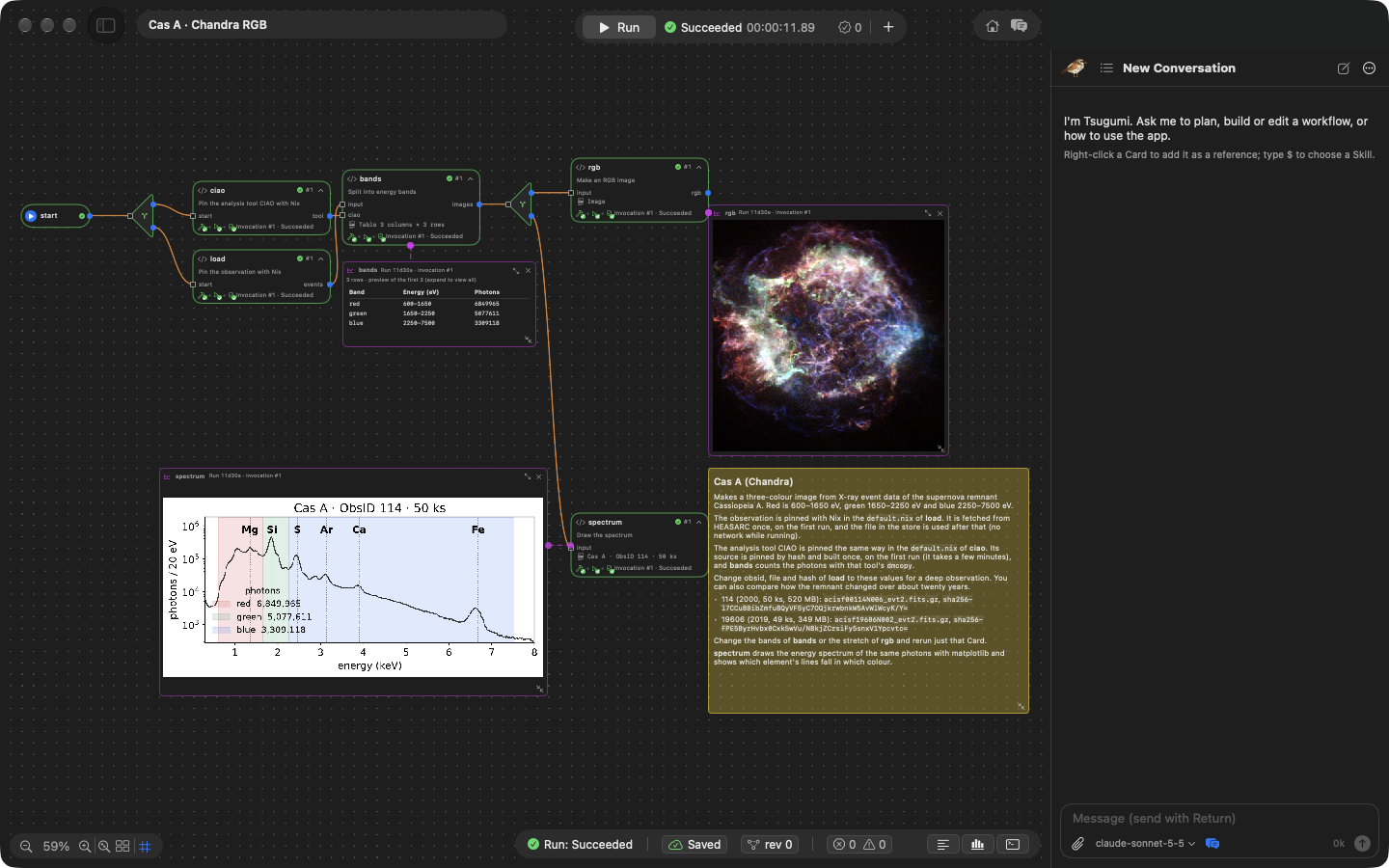
Tsugumi is a macOS app for assembling computation and data processing as a graph of Cards (a Workflow).
- Draw. Place Drafts, which have only a name and a description, and wire them up to design the whole flow.
- Implement. Leave a Draft to the Agent, or write C++ / Python / bash / R / Julia yourself. The generated code stays in the project as ordinary files that you can reread and edit at any time.
- Check. Run the graph in environments pinned with Nix, and look at each Card’s progress, outputs and logs. When you fix a step in the middle, run again from there at once, with the saved inputs.